

ARTICLE
As a Green Foreign Policy Fellow of the Heinrich Böll Foundation Thessaloniki in 2025–2026, Gunel Madadli investigates where and how the feminist foreign policy and green foreign & security policy narratives interact and complement each other. She examines how intersectional analysis can reshape global justice strategies across climate, security, and human rights amid growing polarization.

Introduction
Climate, sustainability, feminism, human rights, and justice are often overlooked in traditional power politics, but the Green Foreign & Security Policy (GFSP) narrative argues that without addressing the insecurities, such as poverty, inequality, climate change, forced migration, and resource scarcity, sustainable peace cannot be achieved (Astyrakakis Aslanis, 2023). Furthermore, these challenges do not belong to one country, as they are shared struggles; hence, they require cooperation, not competition. This renewed approach suggests a shift in military expenditure in defensive and humanitarian aims, keeping with green values through conflict prevention, crisis management, peace mediation, and development aid. It also supports civil protection and dual-use roles of the military (e.g., disaster relief, humanitarian support), not just traditional warfare. Hence, some of the Green parties in Europe debate on military cooperation together with transparency and democratic oversight, avoiding militarization as a power projection.
Moreover, the concept of security has been redefined in recent years due to the expansion of threats as well as the transformation of understanding risks outside of its traditional meaning. Countries can no longer ignore environmental security, including climate, food and water, human security, including migration, health (pandemic and epidemic), political and economic security, especially within the foreign policy framework. Considering 11 countries formally committing to Feminist Foreign Policy (FFP) (Whipkey et al., 2025), and more than 90 countries framing climate and environmental change as security issues (Vogler, 2023), it can be assumed that countries are ready to develop a new concept for their foreign policy strategies. Within my fellowship in Green Foreign & Security Policy (GFSP) at Heinrich Boll Foundation Thessaloniki Office, I have a chance to combine these two perspectives (feminist and green lenses), to examine the security and foreign policy directions of three countries. My goal is to investigate how the principles and practices of FFP can be meaningfully integrated better into the GFSP narrative to produce coherent, intersectional strategies for global justice.
Why is this relevant?
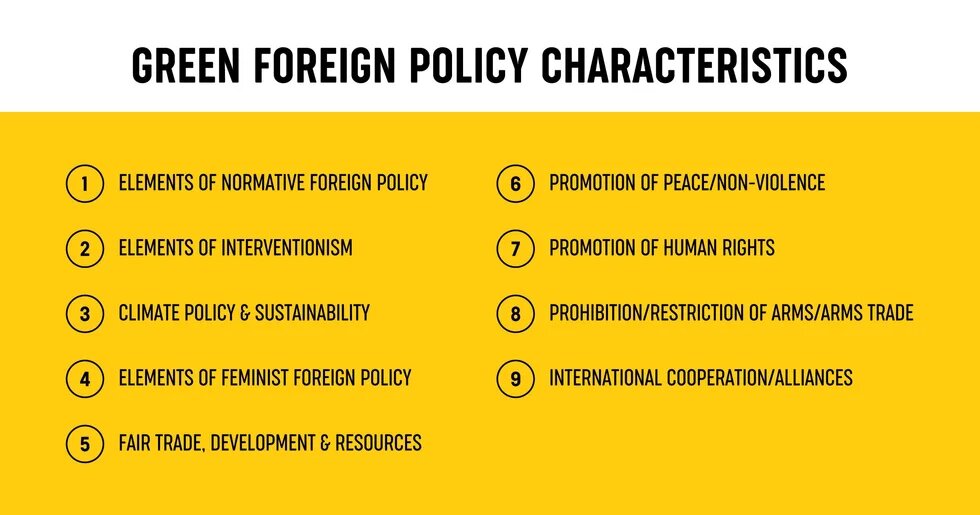
The Green Foreign & Security Policy narrative is not only about environmental protection but also about prioritizing normative values, such as peace and human rights, developing a climate diplomacy, and encouraging sustainability, pursuing fair trade, development, and resource justice while having clear strategies for arms control and disarmament (Ahmad et al., 2024). Since green security has expanded from state-centered to human security (Miswar, 2025), adding feminist values is essential to address migration, climate, and inequality issues. The GFSP narrative recognizes climate change and resource scarcity as security threats in addition to militarization and conflicts. It also acknowledges that these risks affect women differently from men.
This disproportionality also shows itself in the effects of environmental degradation, which causes forced migration, hunger, and social problems. Elements of feminist foreign policy are an integral characteristic of the GFSP narrative and that is especially important given the widespread failure to implement this aspect by various organizations working on issues addressed by the narrative. For instance, the EU Climate Security Action Plan (2008–2020) failed to integrate gender-disaggregated data or address the specific vulnerabilities of displaced women, leading to limited impact on food and water security initiatives, while the UN Climate Security Mechanisms focus primarily on state-level risk assessments, often overlooking the everyday insecurities of women in fragile and conflict-affected areas.
Another example is the Carbon Border Adjustment Mechanism within the European Green Deal which lacks a gender-sensitive lens in its economic and trade measures, failing to account for how decarbonization policies affect women-dominated labor sectors in the Global South. Moreover, the Gender Action Plans agreed in earlier COPs, while promising on paper, have suffered from weak implementation and insufficient funding for women-led climate adaptation initiatives. In other words, there is ample evidence that the holistic approach brought about by the GFSP narrative has a clear added value. To look closer into this potential and the juncture of FFP and the GFSP narrative, I’ll be looking into specific countries as case studies.
The road ahead
Germany, Chile, and Canada have all adopted feminist foreign policy at some time, while they also currently have strong green parties who either participate or have participated in the decision-making process for foreign policy. The diversity of governmental systems in these countries provides an opportunity to explore policy at different levels. In detail, they have different political systems, economic structures, and regional challenges, which help to analyze the similar policies and commitments from different angles. That is why they have been chosen as case studies for the qualitative comparison, I’ll be conducting document-based analysis as well as qualitative interview data, during my Green Foreign Policy Fellowship.
With this data, I will examine how the intersection of gender, environment, and security redefine traditional understandings of global justice and power relations in foreign policy, looking through the current operationalization of feminist and green priorities. After identifying policy gaps, contradictions, or synergies that exist between gender equality goals and environmental/climate objectives, I will develop a framework that can be implemented to measure intersectional outcomes in feminist-GFSP initiatives. This framework is aiming to further cross-pollinate feminist foreign policy principles with the GFSP narrative, going beyond dry environmental governance and looking into the underlying global inequalities. But what would a feminist analysis be without the 4Ps?
Participation, Protection, Prevention and Promotion. These four points of reference defining the 4P approach will be at the center of my analysis on the intersection of feminist policy and the GSFP narrative. As a result, any conclusion from this research effort will be shaped into these four strands. It must be underlined that each of these four elements have a specific approach in the context of FFP and there lies the added value in applying the 4Ps as a tool for this analysis.
Indeed, in the context of FFP, participation means inclusiveness in decision making and that is also from an ecological point of view as it is translated in the involvement of local and indigenous knowledge in environmental governance. The integration of this concept provides a gender-sensitive climate negotiation for example, meaning the involvement of women and other vulnerable social groups coming from local and indigenous communities. The intersectional approach here is especially important as they are able to contribute to the development of environmental policies, security threats, and mitigation processes. In other words, participation is not understood as a mere notetaking of presence but as a tool for meaningful co-decisions and a denominator in common understanding by all stakeholders on a given issue.
Protection is another key aspect. As one of the marginalized groups, women have faced different security threats during wars and conflicts, including forced migration, gender-based violence, etc. Within the feminist lenses, protection includes providing different foreign policy strategies targeting women and other vulnerable social groups during periods of war. Importantly, the GFSP narrative recognizes the importance of mitigating ecological harm and displacement through Climate Policy & Sustainability, Elements of Feminist Foreign Policy and the Promotion of human rights (characteristics 3, 4 & 7). This includes the forced migration due to climate crises such as floods, famine, and pandemics, as well as the destruction of lands, houses, and water sources due to environmental disasters. In essence, the aspect of protection comes up naturally when cross-pollinating FFP with GFSP and that is an important thing to note. Indeed, whether defining the Promotion of Peace/Non-Violence (characteristic 6) or delineating the Elements of Interventionism (characteristic 2) as integral parts of the GFSP narrative, the aspect of protection is key to properly contextualizing them. All in all, the cross-pollination approach supports climate-linked threats to women and other vulnerable social groups, including gender-based violence in a protection framework.
Prevention is another aspect of special significance in feminist analysis. FFP understands gender inequality as a systemic issue, focusing on root cause analysis of this structural problem. In addition to that, acting early to prevent environmental threats is central to the green approach. In essence, prevention is not understood as a mere ad hoc measure when the need arises but rather as a systemic approach to solving a problem. Within intersectional integration for example, global justice is prioritized by applying a justice-first security model. This highlights social and ecological justice over short-term stability. It also includes gendered poverty, environmental dispossession, and unequal risk exposure, as well as preventing conflict by addressing distributional inequalities. It is important to note here that distributional inequalities can take many forms, and these include unequal access to land, water, energy, as well as to decision-making power.
As indicated above, neither gender issues nor climate belong to one country. Since they are shared struggles, they need to be addressed globally, and so promotion is important. FFP advances gender justice at international platforms by trying to get the involvement of as many countries as possible, while the GFSP narrative adds another array of aspects that include promoting sustainability and climate ethics. The combination of these approaches would be a noticeable normative shift in global governance, and there lies the real challenge, going beyond my work during this fellowship. Indeed, achieving this normative ground is quite a challenge at the moment, considering the current political atmosphere internationally. In fact, countries are being pushed to withdraw from international acts, such as the Istanbul Convention or the Paris Agreement. At the same time, the shifts of authority, value polarization, and legitimacy deficits in global governance generate organized resistance against liberal norms, especially under conditions of crisis and inequality (Alter & Zürn, 2020). In this sense, promotion is not only important as part of the analytical lens but also especially relevant for the disruptive potential of conducting foreign and security policy at the nexus of FFP and GFSP narratives.
Conclusion
My research is grounded on that neither feminist nor green narrative alone can address the insecurities faced in foreign policy application. Hence, bringing the 4P framework to build a systematic dialogue between these two lenses, aims to move beyond the parallel discourse, and generate integrated analytical and policy-oriented approach.
Conducting a qualitative comparison of Germany, Canada and Chile helps to map the future of feminist and green priorities in the current, polarized international context while both narratives are facing political backlash and having an uncertain future. Rather than evaluating the outcomes, I aim to identify the conceptual gaps, institutional constraints, and opportunities for deeper intersectional integration.
This analysis will help to establish a practical analytical framework that can be used to assess and measure the intersectional coherence of feminist-GFSP initiatives. While translating 4Ps into concrete indicators applicable to climate diplomacy, security policy, development cooperation, and crisis response, more coherent, justice-oriented, and prevention-driven foreign policy strategies can be developed during increasing geopolitical fragmentation.
References
Ahmad, T., Saeed, S., & Kukreti, M. (2024). Shifting Priorities: Global Geopolitical Events and the EU’s Foreign Policy Approach to Sustainable Development. Journal of Climate and Community Development, 3(2), 53–68.
Alter, K. J., & Zürn, M. (2020). Conceptualising backlash politics: Introduction to a special issue on backlash politics in comparison. The British Journal of Politics and International Relations, 22(4), 563–584. https://doi.org/10.1177/1369148120947958
Astyrakakis Aslanis. (2023). Green Foreign Policy Snapshots: Preliminary Findings. Heinrich Böll Foundation Greece. https://gr.boell.org/sites/default/files/2023-09/30285003-gfps-preliminary-findings-report-en.pdf
Miswar, S. H. (2025). Rethinking Security in the Anthropocene: A Multidisciplinary Paradigm Shift in International Relations. Khwopa Journal, 7(1), 156–176. https://doi.org/10.3126/kjour.v7i1.80151
Vogler, A. (2023). Barking up the tree wrongly? How national security strategies frame climate and other environmental change as security issues. Political Geography, 105, 102893. https://doi.org/10.1016/j.polgeo.2023.102893
Whipkey, K. M., Ahmed, S., & Thompson, L. (2025). Defining Feminist Foreign Policy.